
Journal
What Is a Nastergal? The Wild African Berry Behind Our Konfyt
26 June 2026 · Zuidvaal
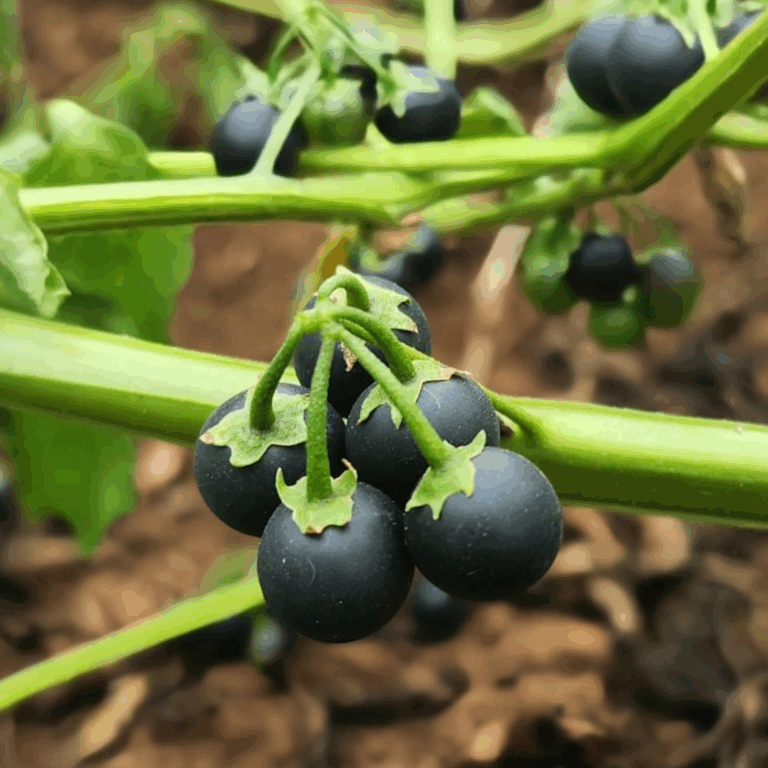
A nastergal is a small, dark wild berry from the African nightshade family (Solanum nigrum / Solanum retroflexum), known in Afrikaans as nastergal and in isiZulu as umsobo or msobo. When fully ripe it turns a deep, glossy purple-black, tastes mildly sweet and gently earthy with a soft tomato-like tang, and is the berry we hand-harvest on our Highveld farm to make traditional nastergal konfyt. It grows wild across Southern Africa and is sometimes called sunberry or wonderberry in English. Importantly, the ripe black berries are widely eaten and have been for generations — it is the unripe green berries you must leave alone, and this is not the same plant as the toxic “deadly nightshade.” We explain all of that, carefully, below.
Nastergal at a glance
If you only read one section, read this one.
- What it is: a small wild berry of the African (black) nightshade family — botanically Solanum nigrum / Solanum retroflexum.
- Names: nastergal (Afrikaans), umsobo / msobo (isiZulu), and sunberry or wonderberry in English.
- Is it edible? Yes — when ripe. The fully ripe, dark purple-black berries are the part traditionally eaten and preserved. The unripe green berries should not be eaten (more on the why below).
- Taste: mildly sweet, slightly earthy, with a gentle tomato-like tang.
- Colour: deep purple-black, thanks to natural pigments called anthocyanins.
- Where it grows: wild across Southern Africa, including the Mpumalanga Highveld where we farm.
- What we make from it: nastergal konfyt — whole berries preserved in a deep purple syrup.
That is the short version. Because this is a berry that carries a few honest “yes, but” caveats, the rest of this article unpacks each one properly.
What does nastergal look and taste like?
A nastergal plant is a low, soft-stemmed bush rather than a tree. It carries small white star-shaped flowers, and after those flowers fade it sets clusters of little round berries that look a bit like miniature tomatoes — which makes sense, because tomatoes are cousins in the same broad plant family.
The berries start out green and hard. As they ripen they swell, soften, and deepen through to a rich, almost-black purple. That dark colour comes from anthocyanins, the same family of natural pigments that give blueberries, blackberries and red cabbage their deep hues.
The taste is what surprises people. A ripe nastergal berry is mildly sweet with a slightly earthy note and a gentle, savoury tang that lands somewhere between a ripe tomato and a soft summer berry. It is not a sugary fruit-bowl sweetness — it is more grown-up than that, which is exactly why it works so well alongside cheese and roasted meat. Cooked down into konfyt with a little sugar, that earthy tang mellows into something warm, glossy and quietly sophisticated, with a deep wine-dark colour in the jar.
Nastergal, umsobo, msobo: one berry, many names
Few wild foods carry as many names as this one, and that is part of its charm. The name simply changes with the language and the region.
- In Afrikaans, it is nastergal — the name most South Africans know it by, and the one on our label.
- In isiZulu, it is umsobo (sometimes written msobo), a name used widely for the berry and the dishes made from it across the country.
- In English, you will see it called sunberry, wonderberry, blackberry nightshade or simply black nightshade.
All of these point to the same edible berry of the Solanum nigrum / S. retroflexum group — what botanists often call the “African nightshade” or “black nightshade” complex. We mention this because the word “nightshade” understandably makes some people nervous. So let’s deal with that head-on.
Is nastergal poisonous? The ripe-vs-unripe rule
This is the question we are asked most, so we want to answer it clearly and responsibly rather than wave it away.
The honest short answer: ripe nastergal berries are edible and have been eaten across Africa for generations — but unripe green berries should not be eaten. The rule worth remembering is simple: ripe and dark is the eating stage; green is not.
Here is why. Like many plants in the nightshade family (including the green parts of potatoes and tomatoes), the unripe green berries and the raw leaves of nastergal contain a natural compound called solanine. Raw and unripe, it is bitter and can cause no more than a mild stomach upset — the plant’s own defence while the fruit is still developing. (Cooked, the leaves are another matter entirely: they are eaten as a traditional spinach-like dish across Africa, which is where the name umsobo comes from.) As the berry ripens and turns from green through to deep purple-black, that compound drops to very low levels, and the fruit becomes both palatable and the part people traditionally eat. This is precisely why nastergal is always harvested fully ripe, and why we cook only the dark, soft, ready berries.
Two further points matter, and we want to be straight about them:
-
This is not “deadly nightshade.” People sometimes confuse nastergal with Atropa belladonna, the genuinely dangerous plant known as deadly nightshade. They are different plants. Belladonna carries large, shiny single berries and purple bell-shaped flowers and contains powerful toxins; nastergal carries small matte berries in little clusters and white star-shaped flowers. Nastergal is a long-eaten African food plant — belladonna is not. We make our konfyt from nastergal, never belladonna.
-
Foraging is for the experienced — and we’ve done it for you. Correctly identifying a wild plant and judging true ripeness takes real knowledge, and look-alike plants exist. We would never encourage casual roadside foraging. The reassuring part is that you don’t have to: every berry in a jar of our konfyt has been identified, hand-selected at full ripeness, and cooked by people who have harvested this fruit for years. That is rather the point of buying it from us.
So — is nastergal poisonous? Not when it’s the ripe berry, prepared the way it has always been prepared. The caution is real but specific, and it sits squarely with the green, unripe fruit and the leaves — not with the dark berries in your konfyt.
Where nastergal grows and how we harvest it
Nastergal grows wild across much of Southern Africa, often appearing on its own in disturbed ground and field edges after good rains. You cannot really plant a field of it and call it a crop in the usual sense — it comes up where it wants to, which is part of why true wild nastergal konfyt has always been a small, special thing.
We farm at Bloukop Farm near Amersfoort, in the Mpumalanga Highveld. Each year, for a short window in late summer — roughly February into March — the wild nastergal on the farm ripens. It is a narrow season. The berries are hand-harvested, picked one ripe cluster at a time, because there is no machine that can tell a ripe berry from a green one the way an experienced hand and eye can.
The Zuidvaal name has a story of its own. The brand was founded in 2004 by Marie de Jager, who built its reputation on properly made traditional preserves. In 2024, our family — Loutjie and Zelda-Mari du Toit — took it over. We make it now on our own farm, Bloukop — a next-door farm in the same district — with the same recipes and the same hand-harvested wild nastergal. You can read more about that handover and our family on our story page.
From berry to jar: why nastergal konfyt is special
To understand why nastergal konfyt is genuinely rare, you need to understand two things: what konfyt actually is, and why this particular berry almost never reaches a shop counter fresh.
Jam or konfyt? In everyday South African use the two words are used interchangeably — you’ll hear our nastergal called both nastergal jam and nastergal konfyt, and either is right. There’s a subtle traditional difference worth knowing: jam is crushed fruit cooked to a spreadable pulp, while konfyt keeps the fruit whole or in chunks so each piece holds its shape and character. Ours is made the whole-berry, konfyt way — dark nastergal berries glistening in a deep purple syrup, a preserve you can see the fruit in, not a smooth spread. It is the more traditional, more painstaking method, and it shows.
The berries can’t travel. Ripe nastergal is fragile. The fully ripe berries are soft and delicate, and they bruise and spoil very quickly once picked — which is exactly why you almost never see fresh nastergal for sale anywhere. The fruit has to be cooked close to where it is picked, while it is at its peak, often within hours. That single fact is the whole reason nastergal konfyt is uncommon: it simply cannot be shipped fresh to a factory. It has to be made by people on the farm, in season, by hand. When you open a jar of ours, you are tasting a fruit that most South Africans have never seen in its fresh state. You can see the full range on our products page.
How to enjoy nastergal konfyt
Because nastergal carries that gentle savoury-sweet, tomato-like tang, it is far more versatile than a typical breakfast jam. Here are the three ways we love it most.
- On a cheese board. This is where nastergal konfyt truly shines. Its earthy depth is a natural partner for cheese — spoon it alongside a soft brie, a salty blue, or a mature cheddar, and let the dark syrup cut through the richness. It does for a cheese board what fig preserve does, but with more character.
- On warm scones with cream. The classic. Split a fresh, still-warm scone, add a generous curl of cream, and top it with whole nastergal berries in their syrup. The deep colour against the cream looks as good as it tastes.
- As a glaze for braai and game. This is the secret weapon. Loosen a few spoons of konfyt and brush it over lamb chops or venison in the last minutes on the coals. The sugars caramelise and the tang balances the fat, giving you a glossy, deeply savoury glaze. If you cater or run a kitchen and want to put this on a menu, have a look at our wholesale and trade options.
Where to buy nastergal konfyt online
Because the fresh berry can’t travel and the harvest window is so short, properly made wild nastergal konfyt is hard to find. We make ours the traditional way — whole hand-harvested berries, preserved in a deep purple syrup, on the same farm where they grow.
If we have done our job here, you now know exactly what a nastergal is, why the ripe berry is the one to eat, and what makes nastergal konfyt such an unusual jar to own. The best way to understand it, of course, is to taste it.
You can order direct from us and have a jar of genuine Bloukop nastergal konfyt sent to you, or read more about the farm, the family and the de Jager legacy we carry forward on our story page. From our Highveld farm to your table — that’s the whole point.
Taste the berry behind the story
Whole nastergal berries, hand-harvested and preserved in a deep purple syrup on Bloukop Farm. Order direct and have a jar sent to you.
Order Nastergal Konfyt